Friday, December 22, 2006

In Review - "Wonder Wheel" by The Klezmatics (Lyrics by Woody Guthrie)

In the mail... Handed to me at a recent wedding gig... The Klezmatics' new release "Wonder Wheel" featuring their settings of some of Woody Guthrie's lyrics, which he'd never recorded.

I like this album a lot. The 'matics are in fine form on this outing. This is essentially a folk project, but even though they say there isn't much klez on this album, its influence is clearly felt throughout. The musicianship is excellent and the soloists are in top form. Long-time drummer David Licht is no longer with the band on this recording, and his absence allows this recording to illustrate how integral bassist Paul Morrissett is to the band's sound. Licht’s replacement on this album, Kenny Wolleson, plays well, and the producers, GoodandEvil, frequently augment his drumming with tabla and other percussion.

The recording features several guest musicians who play an integral role in this project's sound especially Susan McKeown on vocals and Boo Reiners on guitars and banjo.

From the fun zydeco of Frank London's "Mermaid's Avenue" to the playfulness of the lullaby "Headdy Down" by vocalist Lorin Sklamberg, and from the klez of Matt Darriau's Goin’ Away To Sea --which was apparently not written by Guthrie, a fact discovered after the song was recorded-- to a poignant "Orange Blossom Ring" (also by London), “Wonder Wheel” demonstrates the appropriateness of the “shidduch" between the band and Guthrie’s lyrics.

Violinist Lisa Gutkin’s setting for "Gonna Get Through This World" is stunning. Probably my favorite track, but I liked most of them. Susan McKeown is featured here to great effect. The alternating trumpet, clarinet, and violin fills are just beautiful and the tabla drums add some very nice color. It’s folk, but with the Klezmatics’ unique world music touch.

Reedman Matt Darriau's composition "Pass Away" is an intriguing Eastern sounding track that sounds much like his work with one of his other projects, "Paradox Trio".

The production on "Wheel of Life" sounds too dense to my ear, I'd have preferred some more sonic space in the arrangement. GoodandEvil overdid this one, In my opinion.

In short, the music on "Wonder Wheel", much like Guthrie's lyrics, is not overtly Jewish, yet it somehow has a Jewish flavor throughout.

This is not a Jewish album, yet, this is a very Jewish album.

Amazon has it here:

Friday, December 15, 2006

Drummer Available

Shmuel Klaver writes:
I would like to thank my friends, mostly musicians, for all of their well-wishes following my (2nd) stroke last October. Thanks to all of your tefillos, I have pretty much fully recovered B"H, giving me once again the opportunity to be upset with Neginah for not giving me any work... I would like to ask a favor, though.
I've been without a parnassah for quite some time, but I am now teaching again; so if any of you hear of someone in the Monsey area looking for drum lessons, or if any drummers out there need a last minute sub for a Monsey-area shmorg because you're running late, please keep me in mind. I can be reached at 845-694-8235 or SHMOO954@hotmail.com. I appreciate your posting this; I know it's a bit unorthodox (oy-in Monsey, yet!) Love to all - Shmuel Klaver

Tuesday, December 12, 2006

From the mailbag...

Psachya writes:
Along the lines of your "peeps in the hood" - I did a gig recently that had more than its share of optimists, and I thought I'd share their optimism with you. Here goes:
- I met Optimist #1 before I even got into the hall. I had parked my car down the road from the hall. Half of my equipment (keyboards, sound system, etc.) was on the sidewalk; the other half was still in the car, with the hatch open.I believe I had an amp in my hand when the Optimist pulled up next to me and asked, "Are you pulling out now?" (This happens to me frequently, but only in Brooklyn. It must be something in the water.)
- Optimist #2 was the fellow who wrote on the prep, "We want it lebedig but not crazy." His optimism was rewarded, BTW. I think.
- Optimist #3 walked up to our sax player and informed him that he was to play in a "legitimate style (gotta love it), not this CRAZY FUNK STUFF that everyone plays nowadays." Our sax player that evening was a young Israeli whose style was both extremely funky and quite legitimate. But not exactly the Howie Leess/Pitz Lamm klez tenor style that this fellow was looking for. (At least I assume that's what he was looking for.)
- Optimist #4 walked up to us during the smorg. He was holding an iPod or some such thing. "There are three really nice niggunim on here," he said. "Could you guys learn the songs now so you can play them during the dancing?"
- Optimist #5 (he must have known #4) said that his favorite song in the world was a certain Adi Ran tune. "You guys know it, right?" Wrong.
It happened to be a very enjoyable gig. Despite all the optimism.
You don't know every Adi Ran tune?!?!?!

Hilla Hoitash at the Israeli Consulate's Dept. of Media and Public Affairs writes:
I just wanted to bring to your attention to our new Blog. This is the official Blog of the state of Israel, the first state Blog out there. It's edited by our team of young professionals here at the Israeli Consulate in NY. Let us know what you think?

Here's the link www.isrealli.org
I took a quick look, and the blog will be featuring profiles of Israeli musicians you may not have heard of.

A Simple Jew asks:
Is it possible to release a song without the words "Yerushalayim" or something that ends with the suffix "einu" (ex. Elokeinu) in the lyrics?
Sure! Na, Nach, Nachma, Nachman Me'Uman!

KFAR's Adam Davis writes:
hey there. got a couple cool events coming up in Chicago.... details at http://kfarcenter.com

He Who Pays The Piper Calls The Tunes!

So this older gentleman comes over at tonight's gig to compliment our volume and shares the following story.
"I was at a wedding recently, and the band was playing way too loud. So, I went over to the bandleader and asked him to lower the volume. He refused and told me that's what the bride and groom wanted.

So, I told him...

I don't care what you say my daughter wants! I'm the one paying you, so turn it down now!"
Turns out this exchange happened at his own child's wedding.

Note to bandleaders: if you don't play too loud, this won't happen to you.

Tuesday, December 05, 2006

From the mailbag...

Psachya writes:
I'd like to address some of Ron B.'s comments regarding the use of headphones or earbuds by club-daters. I have recently done some gigs with Yochi Briskman of Neginah, and he has a setup similar to the one described. As a sideman, I found several distinct advantages in using the headphones:
- I essentially had my own private monitor & mix, which I could alter at any moment. If nothing else, it's a lot of fun. For example, if the sax player is doing a hot solo, I can boost him a little; if he's doing routine section stuff, down he goes. It's a hoot!
- More importantly, it makes it easier for particular musicians to hear each other efficiently. As the keyboard guy (usually playing a bass split), I often find myself with the entire band separating me & the guitarist. (Why bandleaders do that is a whole 'nother blog, but there are legitimate reasons, and I often do it when I lead bands as well.) The problem is, obviously, that we can't hear each other's changes very clearly, and have to make educated guesses as to what the other one is playing. This problem is eliminated with the 'phones - in many ways, it makes the band sound tighter.
- I can actually hear myself play. (If no one else, the keyboard players out there will know what I'm talking about.)
- As I use the heaphones as opposed to the earbuds, it has the added advantage of acting like earplugs in terms of blocking out volume, without blocking out the actual music.
- When Yochi uses this system, he has his own twist - he has one mike set up for his voice to go only into our phones. This way, he can instruct the musicians in their ears without having to shout over the music. This obviously leads to a much more efficient gig, and the bandleader can put much more of his own stamp on the gig as it is in progress. For Yochi, who leads from the drums, this is obviously a particular advantage.
- In regard to some of Ron B's other points, I see his point regarding the use of monitors AND headphones. There may be a reason for it - I'm not a tech guy, so what do I know. Also, I can't speak for the sound on the floor - it's hard to guage that from the bandstand. I will say that having an engineer - wherever he is situated - beats what I see 95% of the time, which is no engineer at all. Usually the bandleader runs the sound, and has to rely on field reports, which usually consist of an old lady telling us that we're much too loud at around the same time that a bochur is telling us that we're not loud enough. So having an engineer is a step in the right direction - let's not discourage that, shall we? There are times that "techno razzle-dazzle and sizzle-sazzle processing" (to use Ron's words) actually makes the music sound better. Here's hoping.
K. writes:
wondering about neginah.. Did you have a bad experience with them???

Just read something weird..in a negative way. And I booked them for my wedding.
My response:
Neginah is a large well-established band that has been playing for many years. I’m sure you’ve heard them before, liked what they do, and that’s why you hired them. They can do a very nice job and many people are very happy with their work.

I’d not let something some blogger wrote cause you too much worry. :)

If you have a specific concern, you probably should talk it over with them.

If I can be of further help, please don’t hesitate to ask.

Mazal Tov on your wedding!

12/5/06 Link Dump

Mo C writes about how downloading is affecting CD sales.

Isreality comments on the fact that Israelis are always singing.

Ben Jacobson says "just say Noy!"

The Forward tells "A Cantor's Tale".

The Jewish Week profiles SoCalled.

George Robinson writes up Brave Old World.

Betcha always wondered what Santa does the rest of the year. I actually met Kirk when I played a gig in Houston and one of the musicians in the band rented a sousaphone from him.

New Agudah Takanos

Although some bloggers have covered the recent Agudah convention session on blogs, none seem to be aware of a leaked post-convention memo proposing takanos on blogs.

Blog in Dm's intrepid investigative team is glad to be able to share these hitherto undisclosed proposals with you.

Agudath Israel Internal Memo -- FOR INTERNAL RELEASE ONLY

Dear fellow Moetzes member,

Enclosed, please find a draft of the proposed takanos on blogging as per our meeting at the Agudah convention.

Draft Takanos on Blogging

A group blog may consist of a maximum of 5 bloggers. One of the bloggers may act as a comment moderator or else the blog may have 4 bloggers and one additional regular commentor.

A one-man blog is recommended.

The "blogoversary" celebration is to be discontinued. The 1,000,000 hit celebratory post should not be turned into a "blogoversary" .

Only 400 readers may sit at their computers to view a blog at the same time. After 10 PM, bochurim may be invited to read blogs, but they may not have seats while reading.

For those who like to snack while reading blogs, snacks should be limited to basic cakes, fruit platters, a modest buffet, and the standard meat or chicken hot dishes. Sushi blogging is prohibited!

Bloggers who imbibe while blogging may only drink Gordon's vodka or Old Willamsburg, Old Overholt, or Old Crow.

Bloggers may only use free or low-cost blogging solutions like Blogger.

It is forbidden to host your blog on a server that is less than five years old. (You've heard of yeshivishe cars? Well, we're mandating yeshivishe servers.)

The total cost of a Blogads purchase should not exceed $1800.

We the rabbinical signatories -- barring familial obligations -- and unusual and extraordinary circumstances --will not guest-blog or comment on a blog that disregards these guidelines.

I look forward to hearing your thoughts, heoros, and chiddushim.

With Torah blessings,
Rabbi Y. Perlow, Novominsker Rebbe, Yoshev Rosh -- Moetzes Gedolei Hatorah of Agudath Israel of America

Tuesday, November 28, 2006

11/28/06 Link Dump

Over at Jewschool, matthue gets all snarky 'bout Debbie Friedman.

Over at the Klezmer Shack, Ari's on a roll with lots of CD recommendations.

Is Mizrachi music in trouble?

The Jewish Week reviews a number of CD's including Shlomo Katz's latest.

Speaking of the JW, here's a Letter to the Editor by Harriet Goren:
I was saddened by your headline for the article “Fighting Sing-Along Services” (Page 3, Nov. 10) as well as by comments of participants in The Art of Synagogue Music conference.

I agree that a cantorial or choir solo can transport spirits to amazing heights. But so can “singing along,” joining together in strength with other voices and participating fully in prayer rather than waiting for an expert do all the work. Judaism, after all, is about action. Most synagogues in this country offer an experience of congregational prayer by proxy, as if the chazan alone was qualified to speak to God. No wonder attendance at services continues to decline and havurot, small lay-led groups, proliferate: everyone’s voice counts in a havurah.

Participatory music need not be “lowest common denominator,” as composer Jack Gottlieb asserts; witness the thousands who attend services each week at Manhattan’s Congregation B’nai Jeshurun and raise their non-trained, non-expert voices in melodies that are eminently singable as well as aesthetically sophisticated.

The answer to creating a more meaningful and challenging prayer experience is not to discourage participation for fear of making unpleasant sounds, but rather concentrate efforts on developing music that will, in its beauty and relevance, encourage us to raise our voices as one.
Dag comments on the new Chevra!

Nisht kein Godol comments on the Dei'ah VeDibbur article we recently blogged.

Hirhurim plugs "Gerstner cubed!"

Word!

Messianic Madness (not a Chabad post)

So a Messianic Christian joins the Yahoo Jewish music group and seeks MBD lyrics.

A member asks why his profile says Jesus lives.

His answer: Whoops! "Excuse, but was an error upon creating the phrase! the correct one would be: Am Yisrael chai, Od Avinu Chai! Yeah, right!

Speaking of messies, here's some delicious irony. Did you know that there's afour-piece Messianic band called, I kid you not, Arba Minim?!? You can't make this stuff up!

Wednesday, November 22, 2006

In Honor of the Agudah Convention...

Here's one from our archives.
Also, took a look at the Spring 2003 edition of the RJJ Journal of Halacha and Contemporary Society. Rabbi Alfred Cohen's article on "Daat Torah" in that volume is interesting. In the article, he quotes the Meshech Chochma, who says that the true "sin" of Moshe Rabbenu at Mai Meriva was that he erred in not realizing how his policy would be misinterpreted by the Jewish people.
"Even a great and true Torah leader, whose vision of Judaism is clear and whose wisdom is profound, has to decide not only what is the right thing to do, but also - how the people will perceive it."
In a footnote, he refers to the takanos imposed on wedding expenditures by the Agudah and notes:
As an example, if people were to get the impression that certain individuals are exempt from following recently-issued guidelines for limiting ostentation and excessive spending at weddings, there would be little incentive for others to adhere to them.
Under the circumstances, lack of respect for Daat Torah abounds.
Rabbi Cohen is too kind here. I fail to see how people could not get that impression, given that the text of the takanos explicitly allows for exceptions to these rules.

He also notes in a later footnote:
During the past year, a proclamation was issued by Torah leaders, calling upon all members of the community to accept restrictions and guidelines for expenditures when making weddings. The proclamation aroused a great deal of discussion, as well as debate whether this area was indeed the one most in need of correction -- some suggested that it would have been far more important and worthwhile to place a limit on the costs of Yeshiva education, which places a tremendous burden on thousands upon thousands of families. Be that as it may, the true test of that proclamation's efficacy as Daat Torah will be evident in about five years, when its impact will or will not be noticeable. It is the view of this writer that the factor determining whether this move to influence public behavior succeeds is really dependent upon the behavior of the signators themselves: the first time a wealthy or important individual flouts the guidelines, but the Torah personalities who signed attend his child's wedding anyway -- that will be the end of the projects efficacy.
By this standard, the takanos are already a failure – as it was obvious that they would be. I should note that there are many people who have been abiding by the takanos despite the fact that, even within the “Agudah” community, they aren’t universally followed.
Next year's plenary topic: "Is the RJJ Journal of Halacha and Contemporary Society bad for emunas chachomim?"

NB: One of the benefits of gigging only 10 minutes from home on Erev Thanksgiving is pre-gig blogging. Much better than sitting in traffic for a few hours.

Tuesday, November 21, 2006

The Wedding Present

There's a beautiful story that's told about the composition of the Breslover tune "Oz VeHadar". I thought I'd written about this previosly on the blog, but can't find it in the archives.

I learned the story behind the song from the liner notes on a Breslover album I picked up a while back. The album is titled "Nigunei Neshama" and is a live recording of "beautiful old melodies that arouse one to the service of Hashem, which were sung from time to time in the house of Reb Levi Yitzchak Bender z"l, the head of chasidei Breslov in Eretz Yisrael."
The tune was composed by Reb Meir Leib Blekher z”l. Being extremely poor, and not having anything to give his daughter on her wedding day, he went out to meditate and pray in the fields. When he returned, he said to her: “A wedding dress I don’t have for you, however a nice melody I do have [for you]!” He then began to sing this song to the verse from Eshet Chayil – Oz VeHadar... [as if to say] the main thing is the garment for the Last Day. (Siach Sarfei Kodesh, 3-398)
A lot of people think this is a Carlebach tune. I blame Soulfarm!

From the mailbag...

Robert Miller writes:
1. If anyone wants wants to hear the nearest thing to the real Shlomo they can easily find the recorded Shlomo, or they can sing his tunes themselves. A good tune can have varied good interpretations.

2. We ought to realize that Jews created and sustained a wonderful tune-making enterprise, namely, the American musical theatre of the 20th century. How and when we decided to settle for gaudily arranged boring music that you know before you've even heard it is something to ponder. Hevel's sacrifice was accepted over Cain's because Hevel gave his best. If Torah people want to make Torah music, shouldn't this be our best?
Jordan writes:
From the back cover of Mikdash Melech:

"This is to my great friend Benedict: (The arranger of Mikdash Melech) Thank you for putting so much heart into my songs. Everyone who will hear this beautiful music will love you as much as I do and will miss you as the whole world will. Peace be with you. Shlomo"

In the story of Schvartze Wolf, Shlomo pointed out that a lamed vavnik was like a mirror. If you look at him and see an obnoxiuous person, than you are obnoxious. And if you look at him and see an ugly person, than it is you who are ugly. Well, Shlomo was the same way. If you look at him and see an illiterate out of tune singer with an unkempt beard and dirty shirt, than gevalt, it is your beard that is unkempt and your shirt that is dirty, and by God, it is time you took some guitar lessons and let someone else do the singing. But if you look at Shlomo, and see a sophisticated folk musician who used a variety of settings for his music, and whose songs are firmly rooted in the tradition of eclectic Jewish music, drawing from the Central European Classical music influenced Modzitz dynasty, Russian folk tunes, and German Synagogue Music traditions, as well as Pete Seeger, Leadbelly, and Woody Guthrie, than you're mamesh unbelievable.

Ben Zion Solomon, by the way, did graduate work in Ethnomusicology at UC Berkley.
Ron B. writes:
I just got back from a wedding, I won't mention where or who played but... suffice it to say that it was what you would call a high-class type affair with an 8 piece band and famous guest singer. Aside from the competency of the band and the "star signatures" of the singer, which were fine, some things struck me as off. The hall was large but not huge. The sound system was a full blown front-of-house system, with at least 10 or 12 compressor-expander-limiter sound processors in the rack and each player had earbuds or headphones with an individual mix. The sound engineer, who was situated behind a 24 track board which was also behind the stage and the speakers, was wearing headphones. The sound system had about six 1600 watt amps, which could drive a medium to large size theater, with 4 huge flown speakers and 2 huge subwoofers. Even though everyone had earbuds or headphones, each musician also had a floor monitor including the drummer who sat behind a lexan shield where all the drums were miked.

Why is this important? Well, first off, the position of the engineer and his headphones gave him no clue as to what the sound in the place was like for the audience. Secondly, limiting-compressing and expanding every player completely kills the dynamics of the band and makes everything a constant leveled wall of sound. Thirdly, giving everyone a set of phones or buds where they can adjust their own levels in their own in-the-ear-mix does not give them any idea about what the band really sounds like in terms of dynamics and balance.

To my ears, the entire mix in the hall was dull, muddy and bland, with no nuance or dynamics. It was a shame. Throwing so much technology at live music to squash it when it's loud, lift it when it's low and otherwise homogenize it into and electronic facsimile of a live performance. This in itself is not so bad if it's applied judiciously in what we call a Front of House system. That's where the engineer is situated in the audience position, without headphones and adjusts things according to the way it sounds, using technology as tools to enhance the live show as it happens, adjust the balance for clarity and nuance of expression - not to set some presets to flatten it all while behind a set of headphones.

I don't get why the band needs floor monitors if they all have phones and/or buds. No one really hears the music as it should be heard, including the audience. Maybe the musicians don't care because it's a job and the engineer brought new toys for them, so why make a tzimmes - take the money and run. The famous singer sees all the blinking lights and expensive gear and feels like he's in Town Hall, OK. And the audience, they don't know the difference except they can't figure out why they are getting a headache because it doesn't really sound that loud. It's just and ersatz version harmonically re-processed and re-engineered in real-time to sound good to one guy in headphones, who has to be listening at high db levels to counter the room sound and probably needs an audiologist. But to the audience, it's a fatiguing psycho-acoustical torture on the ears.

What ever happened to the sound of live music? What ever happened to the art of sound engineering? The whole dynamics and nuance of the drum set, violin, horns, vocals were flattened into a stream of fog and mud. The guitar, bass and keyboard sounded electro-mechanical. What the musicians were playing was sounded like it was translated into the sound of AM radio
commercials on the beach with the bass boost and volume turned up.

How is it possible that we managed to perform live music in the past without an overkill of techno razzle-dazzle and sizzle-sazzle processing?

Did we lose our trust in that most remarkable technology which Hashem endowed us with: our ears?

Monday, November 20, 2006

From the mailbag... (Carlebach criticism edition)

Jordan's got my back:
I remember davening for the amud in Rinat Yisrael, my shul in Teaneck, and using the Shlomo nusach as I learned it off the record. A good friend who happened to be in town and was a close associate of Shlomo's came up to me afterward and said, Jordan, that was beautiful, but it wasn't the way Shlomo did it. I responded that that was the way Shlomo recorded it, and while I respect the need to be true to a composers wishes, I was within my rights to use the recorded version, and he should not get tied up in a knot about it. I am one of the most insistent musicians in NYC about playing Shlomo's tunes correctly, but having said that, I also acknowledge that Shlomo, whose formal training was spotty, often sang his songs differently. And I am a little tired of Shlomo neo chasidim try to tell me, who performed with Shlomo on a number of occasion, in a wide variety of settings, "How Shlomo tunes should be done." I think we are talking about a pretty amazing, prolific, heartfelt, generous, funny, learned folk song composer. We are not talking about the secret recipe for Coca Cola.

I agree wholeheartedly with Blog in Dm that the criticisms of Dachs and Williger are small minded, petty, nasty, and one reason of my own, a violation of the spirit of Shlomo's music.
Hear, hear!

"Sonoomee" comments:
I don't think Carlebach took vocal lessons either.
Yitz emails:
With regard to the recent discussion about the various versions, by today’s artists, of Reb Shlomo Carlebach’s music – his niggunim – I’d like to add my 2 cents, or should I say, 2 agorot. We live in a world today where everything can be processed, packaged, and redone artificially, and music is no exception. We can now digitalize everything, to make voices sound like guitars; our modern-day electronic keyboards have drums, bass, brass, flutes, guitar and just about any other sounds coming out of them, besides the usual piano and/or organ sound.

There are many people that feel that things have gone a bit too far. I basically agree with your premise that “if you don’t like it, don’t buy it [or attend the concert, etc.].” But I also feel the pain of where FWQ [Frum with Questions] is coming from. There is a feeling that even Reb Shlomo Carlebach, who was so down-to-earth, “amcha” – a Rabbi, yes, but very much “with the people,” who reached out and communicated with them “ba’asher hu sham” – wherever they may have been, has been co-opted. FWQ is upset that even the Carlebach Shul has decided to use “commercialized,” if you will, versions of Reb Shlomo’s music, rather than those performers who actually knew him, played with him, and have a strong feeling of his music, which they can convey when they perform it. His feelings are legitimate and deserve better treatment than your critique here. Again, I agree with you that the response should be “don’t attend the concert,” but one cannot help but feel that somehow people have been betrayed, “sold out” as it were, for a bowl of lentil soup [see this week’s parsha].

Both you and Psachya cite Reb Shlomo’s recording of Mikdash Melech, or “In the Palace of the King,” as an example of how he used musical arrangers. Although I didn’t know Reb Shlomo when he made that recording, I’ve been told by those who knew him, that he was extremely dissatisfied with it. Not with his songs, however, but with the ‘muzak’-style arrangements. [Personally, at the outset and still today, I cringe at some of the ‘muzak’-sounding backdrops on this album, which remind me of either department store music, or Xmas songs. I bought this record in the early 70s.] Evidence that this was so is the fact that most of those songs were redone on later recordings. Another problematic recording, which wasn’t mentioned, was “Days Are Coming.” This came out when groups like “The Supremes” were very popular, and for some reason, his producer decided to use some ‘supreme-like’ background vocals on some of the songs, notably ‘Yachad.’ Again, I heard from those who knew him that Reb Shlomo was not happy with the results of this recording. Thank G-d that Neshama reissued this recording by removing these vocals, adding much better vocals and instrumentation, although at times the saxophone player got a bit carried away [methinks] in some of the interludes.

If you look at things, besides his very early recordings, with which he was launching his music, Reb Shlomo very often recorded live performances, or, as he did later, brought a live audience of his ‘chevra’ into the studio, to give it a live effect. His “Sweetest Friends” recording is a good example of this.

So to be fair to FWQ, let’s agree that Williger and his ilk are not as authentic as Ben Zion Solomon and Sons. Similarly, the Duo Reim’s recording of Modzitz niggunim is not as authentic as those of Ben Zion Shenker. And I’m sure there are many more examples of this. [There are Lubavitchers that hold that Avraham Fried’s version of Chabad niggunim are not as authentic as Nichoach’s]. But, as you correctly mention, you are free to buy or not buy the recording, to listen or not listen to them [when they come on the radio, for example], or attend or not attend the concert.
My challenge to Yitz, "FWQ" and the others. Produce your list of "authorized" Carlebach performers who "actually knew him, played with him, and have a strong feeling of his music, which they can convey when they perform it." Make sure it's all inclusive, as anyone not on the list will never be allowed to perform any Carlebach songs publically. As well, I'd like a specific list detailing the requirements for each of those categories. Specifically, the following:

1) How well did they have to have known R' Shlomo? Do they need to have known his favorite color? Favorite food?
2) How often did they have to have played with him? Is once enough? What about if they came and played on their own, but weren't invited to by R' Shlomo? What if they can't play well? What if someone never played with him, but has performed extensively with the Carlebach talmidim?
3) What qualifies as having a strong feeling of his music?
4) Similarly, what constitutes "conveying" it? Wishing everyone a "good Shabbos" on Tuesday? Parameters please!

Than we'll discuss the specifics.

Also, it's nice to assert that R' Shlomo allegedly was unhappy with the musical arrangements on "In The Palace of the King" and "Days Are Coming". However, he did record those albums, and he did choose/ work with the arrangers for those albums. Those were decisions that are impossible to reconcile with the perspective of his music some, like yourself, appear to be espousing. Even if he later decided he didn't like the results of those sessions.

Finally, I don't agree with your statement "let’s agree that Williger and his ilk are not as authentic as Ben Zion Solomon and Sons." (For the record, I tend to prefer Ben Zion's Carlebach to Williger's.) It's not comparable to an outsiders recording of music of any specific Chassidic group they are not a part of. Williger and his peers grew up with Carlebach music. It is sung in their shuls, yeshivos, at community events, and they bought, listened to, and sang his music for many years. You might not like the musical direction they've gone with it. But to represent it as "outsider music" is unfair. It has been the soundtrack to much of their lives.

Elsewhere, you've approved of Israeli jazz pianist Avi Adrian's treatment of Modzitzer nigunim. (A great album, BTW.) Adrian is not a Modzitzer and jazz is not exactly traditional to Modzitz. Why the double standard about Carlebach?

In sum, it's perfectly ok for "Carlebachheads" to critique Williger's Carlebach ouvre from a musical standpoint. If you don't like the commercial "Brooklyn" Jewish music style, that's legitimate. I don't muuch care for it myself. But these high-horsed comments are disrespectful, as Jordan noted, to the spirit of R' Shlomo.

Finally, I wrote previously:
The notion that only acoustic guitar players and J-rockers are "authentically" Carlebach is silly. That said, there is a "scene" of musicians who play events throughout the year for the Carlebach shul, often for little or no remuneration, and its a little sad that the Carlebach shul feels it has to go to "name" Brooklyn performers for their big events, rather than showcasing their own.
I think it appropriate for the Carlebach shul to use musicians from within their own community for their events. But that's not because I beleive Williger has no right to sing Carlebach. I'll explain more about my reasoning in the next of my "You Owe Me A Job!" Valid or Not? series.

Requests

Pair o' requests for an upcoming gig: "Ya Ma Mai" and "Um Didee Oh"! It just sounds so unintelligent.

Incidentally, one of these days, I think I'm going to run a series of "Name That Gig" posts, wherein I present a list of actual song requests and ask readers to describe the type of gig played.

"You Owe Me A Job!" Valid or Not? Part IX

Continuing the series...

Here are a few scenarios.

"A long time ago in a shul far, far away..."

Years ago, I was very involved in a community shul. I helped run the beginners service, I taught NJOP's Hebrew crash course, gave a series of shiurim, organized and ran events for the shul, etc. I also played at some of the shul's events. Occasionally for free, and always at a reduced rate. I frequently turned down work for those slots, as well as for the slots I was teaching classes. Yet, there was one event I never played; the shul dinner. The shul was a large shul, and the dinner chairperson never came to any of the events my band played at the shul. The chairperson also made it clear that there was no way my band would be considered, because no one has the right to suggest to do things other than the way this person wanted it.

Should the shul have used my band for the dinner?

Here's another example:

Over the years, I've done a lot of pro-bono and discounted work for two national organizations. (Mainly pro-bono.) We're talking many gigs annually. Yet, when they have their serious events, they call bands who don't/haven't been playing these events for them. Is this fair? What do you think an organizations obligation is (if any) to it's volunteers?

A final example:
I have been playing certain events for several schools for many years. Yet, in one particular school, every time they change their director of student activities , it starts from a blank slate, meaning they call whoever for the gigs, until eventually, I get a call to play one (I am in their Rolodex after all) after which they've (so far) been satisfied and return to calling me for all of their events. This has been going on for over a decade now. I've been through four personel changes, and its been the same way each time. Comments?

Up next, my thoughts on various aspects of this topic. Also, I'll share my perspective on the specific examples cited in this series.

Meanwhile, here's Ron Benvenisti:
I sympathize with the "You Owe Me" posts for the most part but I feel compelled to say, it's not always personal or negative. Sometimes the organization's music "director" changes, or their new boss or new son-in-law has other music "connections". Sometimes they want to go a different musical route, which is not your specialty (maybe klezmer or Sephardic or Simply Tsfat). This happens. Sometimes they just forgot how to contact you. This is where a little marketing effort and good attitude go a long way. Make a timely phone call; put them on your mailing list or e-mail. Touch base now and then especially before event times. It really doesn't take much effort to be pro-active and keep up a friendly relationship.

It happened that I had a great Pesach getaway gig, I moved to NJ and the organization lost my cell phone number. In the tzimmes of the moving and the ensuing shverikeit with schools and agencies I neglected to pass on my new contact info to everyone. Thankfully, I had just put up a website and they found me by searching Google. Another time, parent's wanted to use me for a wedding, but it turned out that the kids wanted Simply Tsfat. I wasn't upset, it's their wedding. Mazal Tov! I was happy for them, this is a once in a lifetime (hopefully) event. I wound up doing a jazzy Smorg through and including the Chosson's Intro and Simply Tsfat did the Chupah and dancing. A great bunch of musical guys too! It was a beautiful, albeit slightly atypical, wedding and it was a lot of fun doing it. The crowd really enjoyed the contrast and transition. Sure, it wasn't a full 4-5 hour paying gig, but the money was still very good. I had a great relaxed time, got to see Simply Tsfat, had a great meal and subsequently booked four jobs in that geographic area, which I never worked before, from people that heard me that night. So, keep in touch and be nice. Not everyone is out to get you, but if it happens, as it most likely will, unfortunately, don't let them do it again and if discretely possible, please warn us about who the creeps are. Maybe we'll have a "Creep Peeps" gallery with names named!
Previous posts in this series:

Blog in Dm: "You Owe Me A Job!" Valid or Not? Part I
Blog in Dm: "You Owe Me A Job!" Valid or Not? Part II
Blog in Dm: "You Owe Me A Job!" Valid or Not? Part III
Blog in Dm: "You Owe Me A Job!" Valid or Not? Part IIII
Blog in Dm: "You Owe Me A Job!" Valid or Not? Part V
Blog in Dm: "You Owe Me A Job!" Valid or Not? Part VI (To Catch A Thief!)
Blog in Dm: "You Owe Me A Job!" Valid or Not? Part VII
Blog in Dm: "You Owe Me A Job!" Valid or Not? Part VIII

Friday, November 17, 2006

More Dei'ah veDibur

Here's part II of Binyomin Rabinowitz's Dei'ah veDibur interview with three chassidic composers. We noted part I here.

Here we brought up the issue of musical arrangements, the musical accompaniment, and we got the impression that the same tune could be done in a Jewish way, so that it would have the proper structure. The exact opposite can be also done. Here too the deterioration is immense . . .

Rabbi Banet: It is like taking a chassidic Jew and dressing him up in street clothes. A Jewish melody has to be fashioned from beginning to end in a Jewish way. Whether it is the musical overture to a song, or the transitions, or whatever, we have to make sure that the whole thing is a warm Jewish niggun and that the accompaniment and the musical arrangement do not steal away the song. There are those who go too far in this matter, and whenever foreign and dissonant tunes are brought in from the outside, it causes a lot of damage and degeneration.
And this:
Rabbi Kalish: I would put it like this: Music in our times is a very strong pointer to the character of a bochur. Especially in the teenage years when young people are looking for someone to identify with, to imitate, to look up to (and I do not need to add that any identification with and desire to be like people who are not gedolei Torah is wrong — and definitely when it involves people who are not so positive, to put it mildly).

When you see a bochur who is drawn to music which is not genuinely Jewish and whose notes are foreign to the spirit of Jewish tradition — and it has, under the heading of `chassidic music,' notes which are very foreign indeed and so far from Judaism that they lack even the faintest scent of it, but rather the contrary — then this is the first warning signal. It means that you need to examine the tapes that he has in his closet, because it shows what company he wants to affiliate himself with or has already affiliated himself with, choliloh.

It is the society he is in that has led him to this—and the minute that he wants to be part of it, he will adopt their music, since that alien sound is a clear indicator of that society. Being or wanting to affiliate with that society is manifested in all kinds of external factors, including the dress code, and the song is another unmistakably clear signal.

It is absolutely clear that pagan, street music, pushes a person when he goes outside. It is a fast mover and a social force that traps one to evil, to the streets.

I feel that I am not saying anything new, it is something simple that everyone knows — even though I cannot point to any specific bochur who went down because he listened to a song that was alien to us, because I cannot possibly know what led to what. But I can point to those for whom it was the first signal of their getting into bad company, and it was the factor that expedited their continued deterioration. Now, that is a clear answer to your question about the danger of idol worship, and the idolization of singers and composers.
I assume this is the reason why Kalish switched to cheesy '70's style horn rock arrangement for his music on/about the Belzer "P'sach Shaarei Shamayim" release.

Wednesday, November 15, 2006

11/15/06 Link Dump

THE LIFE-OF-RUBIN BLOG has a post about the upcoming HASC concert.

Ben Jacobson reviews Ta Shma.

There are two music-related letters in this week's Jewish Week. You just know that the poor guys at Cantor's World got tons of complaints over an inadvertent mischaracterization.

ASCAP has The Hotel Pianist worried about her job security. Not to worry too much. They'll still be after the hotel if they start playing recorded music instead.

Here's a nice resolution.

From the mailbag... (in defense of Williger edition)

The author of "Frum With Questions" responds to Jordan's comments.

I am posting this because I feel it is representative of views I've often seen expressed. My response follows.
I am the author of FrumWithQuestions and I would like to thank you for linking my post. I would love to reply to the guy whose response you posted or would love to him to comment on my blog. I would love for this person to hear the difference between the Williger Carlebach Shabbos albums and Ben Tsion Solomon and Sons Carlebach Shabbos albums. Vocally and musically you cannot compare the two. Not only that the Williger album is "composed" and many of the things are not sung in the right way. I would questions if even Williger has had proper vocal training. How come he did not produce any Shlomo albums while he was still alive? Did they ever perform together? Same questions apply to Dachs. I also want to note that these "concerts" and all of this commercialization did not start until Reb Sammy left the shul. As a result many of the old chevra involved left the shul and moved to Israel or elsewhere because of what is going on there. Who is responsible I don't know but it is wrong and things are no longer done in Reb Shlomos spirit.
I asked him what he means by his assertion that "the Williger album is "composed" and he responded.
Williger as well as alot of these other clowns, pay a composers to write and compose the music they put on their albums where artists such as Ben Tzion are real musicians do everything themselves. I was actually at a Friday night davening with Williger and not only did he sing everything wrong, he did it as a performance. He sings in a way which makes it impossible to harmonize (since he is nasal) and he does it in a way which no one can get involved in the davening which defeats the purpose of a Carlebach davening. These people are in it for themselves and for the money. I don't know how it can be more clear.
The level of animosty evidenced here, which I've seen expressed towards some J-music performers before, especially from "Carlebach afficionados" is unwarranted. The claims made here are for the most part silly and the personal attacks on Williger and Dachs are just nasty. If you don't like a performers style, don't listen to his recordings. It's as simple as that. Musical criticism of their albums is certainly fair, but personal attacks and gratuitous nastiness is just wrong on so many levels.

To address your points:

Do you really believe that it's not OK for a singer to release an album with actual musical arrangements? R' Sholmo Carlebach, whose authenticity you're so vigorously defending, featured the work of arrangers like Milt Okun on his albums. I'd strongly suggest re-listening to "In the Palace of the King". Incidentally, as far as the Williger Carlebach CD's go, I'd say no arrangements were harmed (or even used) in the making of those albums.

The issue of whether or not a singer has had "proper vocal training" is irrelevant. These are recording artists with many albums out. You're not their producer. You're a potential customer. Or not. It's your choice.

Similarly, comparing Williger's albums to Ben Zion Solomon's is also irrelevant. If you prefer Ben Zion's work, that's great. Buy his recordings instead.

The notion that "many of the things are not sung in the right way" is a popular peeve among Carlebach groupies. My readers know that I am interested in tracing the evolution of nigunim, discovering the "authentic" version of melodies, and similar topics. That said, the nature of folk music is that it evolves from community to community as well as over time. Like it or not, many Carlebach melodies have attained the status of folk melodies in the Jewish (not just frum) communities. Different people will sing them differently. It's unfair to criticize a singer for singing a song the way many in his community do.That cat's out of the bag already. Deal with it. Or not. Again. It's your choice. No one is forcing you to attend Williger concerts or buy Dachs CD's.

You ask why he didn't release Carlebach albums while R' Shlomo was alive? That's irrelevant. As is whether or not they performed together. Any artist is entitled to record Carlebach tunes as long as they obtain proper licensing (which is compulsory according to US Copyright laws which also sets the royalty fee) and credit the songs appropriately.

The assertion that Williger et al “pay a composers to write and compose the music they put on their albums where artists such as Ben Tzion are real musicians do everything themselves” is silly too. This isn’t a competition for most talented musician, with the prize being that only the winner can release albums. There are numerous great vocalists in the secular world who “pay [a] composers to write and compose the music they put on their albums”.

The notion that it’s impossible to harmonize with a “nasal” voice is factually incorrect. You might not like the resulting sound, but that’s not what you’re saying. You assert that it’s impossible and that’s just not true.

As far as the whole turning davening into a performance goes… I agree. See here, here, and here.

Finally, you assert “these people are in it for themselves and for the money.” You have no way of knowing this, but even granting your assertion, so what? People are entitled to release commercial albums. If you don’t like them, don’t buy them!

On a related note, Psachya writes:
To add a little to what Jordan said re the recent Carlebach shul concert. If you really want to know what is "authentic" Carlebach, it might be instructive to actually listen to some of Rav Shlomo's original recordings. The folkies & J-rockers will usually point to albums like "Live at the Village Gate," which is just Rav Shlomo & his guitar, as raw as it gets; they'll also point to late recordings with Diaspora Yeshiva Band and future members of Soulfarm - all great recordings, by the way. But how about "In the Palace of the King," one of the first modern Jewish albums to feature a full Broadway-style orchestra, with very sophisticated arrangements? How about "Yisrael B'tach Bashem," possibly his most famous album, featuring none other than Yisroel Lamm & Neginah Orchestra? How about his encyclopedic career retrospective, a multi-album, two-year project arranged by Steve Bill, featuring Yaron Gershovsky on keys? Even his earliest albums arranged by Milt Okun (of Peter, Paul & Mary fame) feature cantorial choirs and the like backing him up. In other words, we can see by Rav Shlomo's own recordings that his compositions work in a variety of settings and styles, which is the mark of truly great music. When someone like Yisroel Williger records albums of "Carlebach Nusach", he is as sincere as anyone (and, by the way, more "authentic" than most). I'm a little tired of people who confuse "authenticity" with "the music I like to listen to". It's intellectually dishonest - just say that you don't care for the style, and move on.
Dov Katz writes:
In response to the recent shenanigans about “renting” CD’s……we have decided that people no longer can download the show for free…but that they need to email us back the mp3 in 10 years, delete the file from their computers, and give us their Ipods. In addition we are charging 10 cookies, 2 Diet Dr. Peppers and a coffee for renting the show…..

Listen to the latest show for more….

Here is a link….

SAMEACH MUSIC PODCAST EPISODE # 27


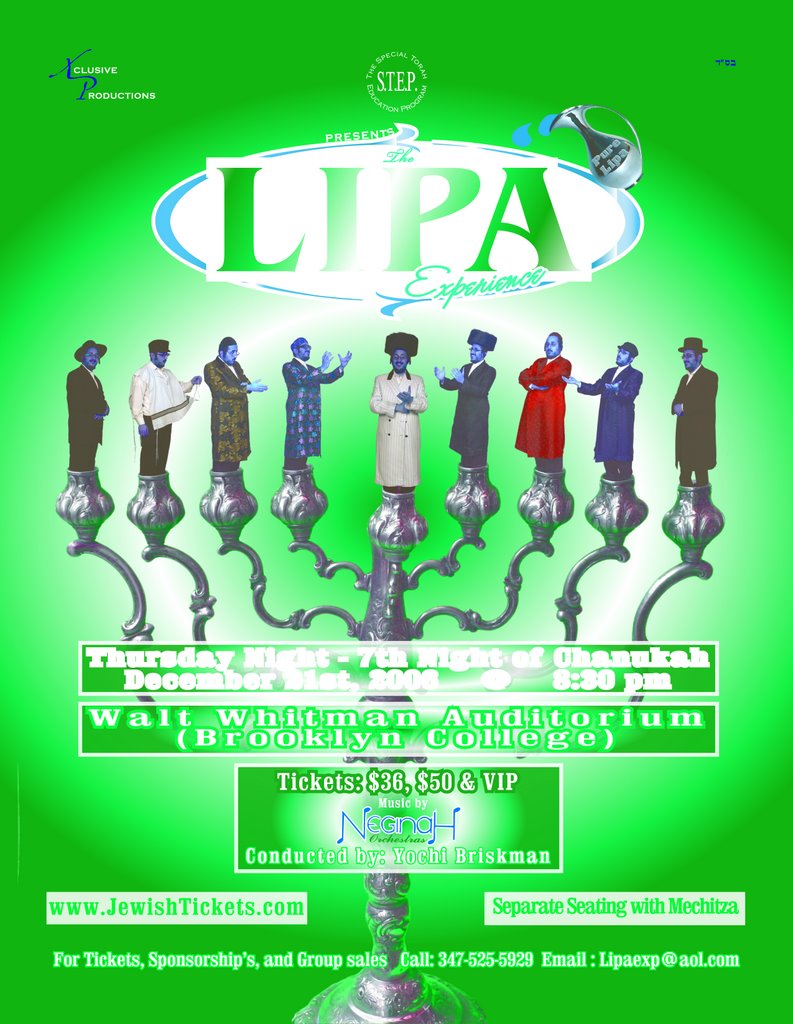
Finally, Jewish Entertainment Magazine forwards a poster for Lipa Schmeltzer's upcoming Chanukah show.

"You Owe Me A Job!" Valid or Not? Part VIII

Continuing the series...

Here's a story representative of many other similar episodes.

Years ago I played a gig for a national Jewish organization. The fellow who called was running a singles event and needed some background music. He didn't have much of a budget for the event, but since it was relatively last minute and for a "good cause", I took the gig at a discounted rate.

The event, a buffet dinner at a now defunct Manhattan eatery, was a bust. About 80 singles showed, but the age (18-50's)and religious diversity of the crowd (on the older side there were miniskirted women and chassidish men, and on the younger side Beis Yaakov type gals and ultra-modern guys ) meant that there were almost no potential matches present. This was immediately obvious to all of the participants on entry. So, I became the de facto entertainment, saving the event, as it were.

At the end of the gig, the fellow thanked me profusely and told me he'd definitely call me again. (I know the gig was a succes, because I booked gigs out of it, and also ran into many of the participants over the following months, who told me they'd liked it.) As you've probably guessed, he didn't even though they run events needing music fairly frequently.

Does this organization owe me anything?

Previous posts in this series:

Blog in Dm: "You Owe Me A Job!" Valid or Not? Part I
Blog in Dm: "You Owe Me A Job!" Valid or Not? Part II
Blog in Dm: "You Owe Me A Job!" Valid or Not? Part III
Blog in Dm: "You Owe Me A Job!" Valid or Not? Part IIII
Blog in Dm: "You Owe Me A Job!" Valid or Not? Part V
Blog in Dm: "You Owe Me A Job!" Valid or Not? Part VI (To Catch A Thief!)
Blog in Dm: "You Owe Me A Job!" Valid or Not? Part VII

Monday, November 13, 2006

10/13/06 Link Dump

Ever want to see a bunch of Israeli Hassidisco singers lip-synch in Ashkenazish?

Jewish Music Blog is criticizing Omek Hadavar. Talk about missing the point.

Here's a great video clip of Yitzhak Perlman learning some klezmer tunes.

ADDeRabbi posts an email to educators about "MySpace" which illustrates the issue why I thus far haven't been linking to MySpace pages on this blog.